Why You Shouldn’t Scale Ads Until You Have a Deep Series
Indie authors with one to three books often feel pressure to “turn on ads” to force momentum. The problem isn’t effort — it’s unit economics. A single title (especially a discounted or free Book 1) rarely generates enough immediate royalty to pay for the cost-per-click reality of today’s ad auctions.
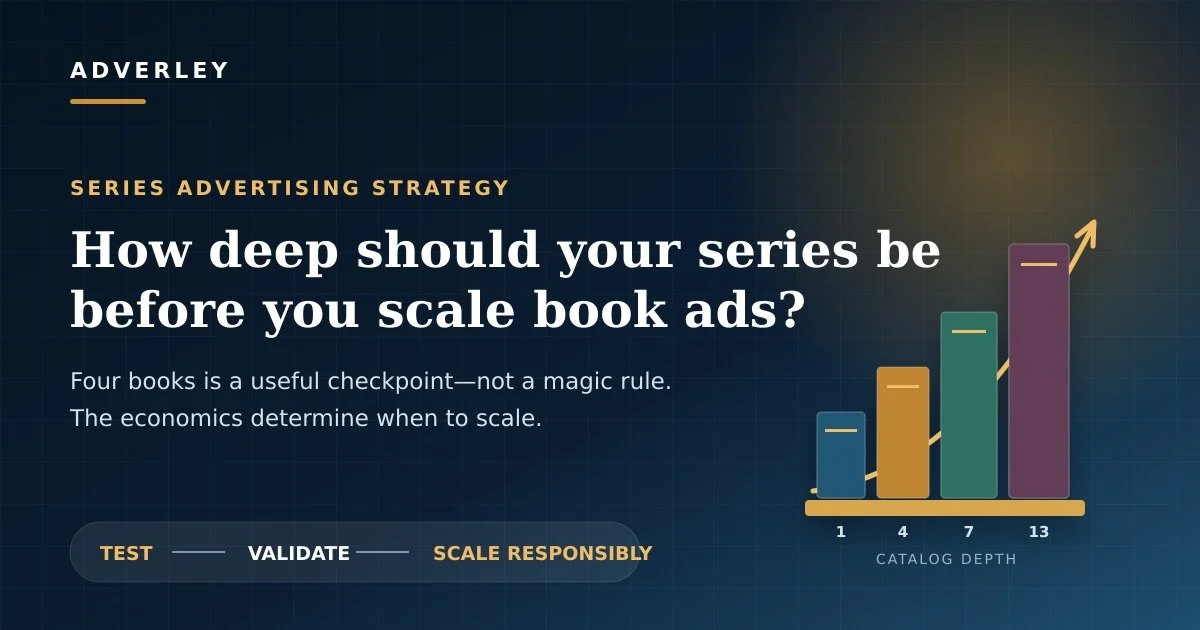
A practical minimum is four + books in one series before you invest substantial ad budgets. Four books gives you: (a) enough follow-on revenue opportunities to make read-through lifetime value (LTV) exceed acquisition cost, (b) enough catalog depth to rotate promos without burning out one title, and (c) enough signal to measure what’s working and scale responsibly.
Evidence from industry surveys and platform case studies aligns with the same pattern: higher earners overwhelmingly have deeper series + active email lists + repeatable marketing systems, and they scale spend only once their backlist can carry it.
This post lays out: (1) the thesis and the math, (2) what changes on each platform when you have 4+ books, (3) a step-by-step roadmap to test then scale, (4) KPIs + attribution methods + budget models, (5) creative levers to maximize read-through, and (6) risks and clear “do not scale yet” triggers.
Thesis and the four-book + economics
Thesis: Substantial advertising budgets make sense only when the revenue generated by a newly acquired reader (including read-through) reliably exceeds the total cost to acquire that reader. With fewer than four books, that inequality usually fails — not because ads “don’t work,” but because the series does not yet have enough downstream monetization steps to pay for traffic.
Why four books is a meaningful threshold
Four books is not magic — it’s a risk buffer:
· Book 1 is commonly discounted (or made free) to reduce friction and get readers into the story world. Written Word Media explicitly frames series marketing around making Book 1 free or $0.99 to “hook” readers and earn on later books.
· At $0.99, many authors are effectively on the 35% royalty option (rather than 70%), which dramatically reduces how much revenue Book 1 can contribute to ad payback.
· Each additional book creates another chance to earn revenue from the same acquired reader — i.e., read-through turns acquisition into compounding monetization, which is why “read-through from series” shows up as a key driver of strong indie earnings in large survey data.
A four-book series gives you three follow-on purchase points after the entry point. Even if your read-through is only moderate, that downstream revenue often makes the difference between “ads are a loss” and “ads are scalable.”
The unit economics in plain English
Most book ads are CPC-based (cost per click): you pay when someone clicks, not when they buy.
That means your break-even math depends on:
· Conversion rate (click → purchase / borrow / page reads)
· Royalty per unit (or page reads revenue in subscription contexts)
· Read-through (Book 1 buyers who continue)
Below is a model (not a promise) using KDP royalty rules to illustrate why Book 1 alone usually can’t carry acquisition cost.
A simple model: single-book vs four-book read-through payback
Assumptions (illustrative): - Book 1 priced at $0.99, earning ~35% royalty. - Books 2–4 priced at $3.99, earning ~70% royalty minus typical delivery costs (KDP notes delivery costs vary; it cites average delivery costs around a few cents).
- “Weak / Moderate / Strong” read-through scenarios are expressed as conditional progression rates (Book 1→2, 2→3, 3→4).
- This is eBook-only math; print costs and discounts complicate margins.
Estimated lifetime royalty per acquired reader (LTV, eBook-only example)
What this means: if you discount Book 1, the royalty on Book 1 is too small to tolerate typical paid traffic costs unless your series monetizes readers after Book 1. Four books materially increases how much acquisition cost you can bear — and it gives you more resilience when read-through is not perfect.
Data gap note: there is no single public “average read-through rate” that applies across genres, price points, and formats. Many practical read-through calculations are taught via industry resources (e.g., “sell-through”/read-through methods) because every author must measure their own funnel.
Evidence and case-study signals
Survey evidence: more books, deeper series, email lists, and steady marketing spend correlate with higher income
Written Word Media’s large annual survey (1,346 respondents in the 2025 edition) emphasizes that catalog size is strongly predictive of earning potential, and that commercial genre fiction’s path to higher royalties is “driven by read-through from series.”
Within the same dataset: - Authors with 1–3 books heavily cluster in the lowest income bracket (under ~$100/month).
- The authors making $5k–$20k+/month “almost always” have deep series and a consistent release history.
- Email list size correlates dramatically with income; the survey reports much higher median income for authors with an email list versus those without.
- Higher earners report higher marketing spend, but the pattern includes a ramp: lower-income authors commonly spend under ~$200/month and scale gradually as catalog and systems mature.
This is not proof of causality — the survey itself flags correlation limits — but it’s consistent with the four-book argument: scale comes after depth, not before.
Platform case studies: “promote the first-in-series, earn on read-through”
On BookBub, multiple partner case studies show strategies built around discounting or promoting a first-in-series title to stimulate sell-through/read-through.
In one detailed case study, fantasy author Danny Knestaut: - Ran tests with small budgets ($5–$12) and high bids to learn which audiences responded.
- Reported CTR as high as 16.5% when creative and targeting aligned.
- Described ROI measurement for free Book 1 promos as “tricky,” and explicitly focused on book-two sales and KENP reads as the economic engine: “that’s where the money is at.”
In another BookBub case study, author Phillip Drayer Duncan ramped paid ads as his series grew (six books published at the time of the story) and BookBub reports his annual revenue grew dramatically after he began ads (framed as “27x”).
The details differ, but the pattern matches the thesis: ads acquisition is justified by backlist monetization.
Platform-by-platform: what changes when you have four books
Below is the practical “why four books” lens, applied to the channels indie authors usually test.
Amazon Ads and AMS-style campaigns
For indie authors, Amazon Ads Sponsored Products are CPC ads that place titles in shopping results and on product pages; you choose bids and budgets, and you’re charged when a shopper clicks.
Amazon also provides an “author’s guide” framing Sponsored Products as a way to connect books with readers actively searching for similar stories — and it includes series promotion as a specific use case (“cross-sell between books in your series”).
Why four books matters on Amazon Ads:
Amazon ads typically attribute sales mainly to the advertised ASIN, while your real profitability may be driven by later books. With only one book, you’re asking Book 1 royalty alone to carry acquisition. With four books, you can treat Book 1 as the ad anchor and let read-through pay you back.
Measurement reality: you will still need to compute “read-through ROI” yourself using KDP reporting (orders/royalties and KENP tabs) because the ad dashboard won’t naturally bundle your entire series LTV into one metric.
Facebook and Instagram ads
Facebook/ Instagram traffic is generally interruption-based: people are not actively searching for a book in that moment. That usually means lower immediate purchase intent than retailer-native ads — but it can be excellent for audience building and retargeting.
The core constraint for book sales attribution: you can’t install a tracking pixel on an Amazon product page. Therefore, measurement usually relies on some combination of: - A tracked landing page (pixel-based) for email signups / reader magnet conversions, and/or - Amazon Attribution links to measure downstream on-Amazon impact from off-Amazon channels. Amazon describes Amazon Attribution as a free measurement solution to understand how non-Amazon marketing influences on-Amazon shopping activity and sales.
- An understanding of platform attribution settings (e.g., click-through windows) — Meta documents attribution models/settings in official help content.
Why four books matters here:
With one book, cold social traffic is usually too expensive unless you already have strong conversion assets. With four books, your objective can shift from “sell Book 1 today” to: - Acquire email subscribers (lower-friction conversion), and - Monetize them via series promotions and launches over time, which the WWM survey shows is associated with higher author income.
TikTok, BookTok, and short-form video
TikTok is a major discovery channel for books; mainstream business and cultural reporting cites BookTok as a meaningful force reshaping how books get discovered and sold.
From a paid measurement standpoint, TikTok is explicit that you need a TikTok Pixel to properly measure website attribution, and it documents attribution windows and conversion definitions.
Why four books matters:
TikTok is often best viewed as top-of-funnel for authors: awareness → curiosity → sampling → binge. Series depth is what turns that curiosity into sustained revenue. With four books, the “binge path” exists; with one book, virality can still happen, but monetization is fragile and short-lived.
Hopefully this information was helpful. If you already have four or more books in a series and would like help starting or optimizing your advertising program, feel free to send us an email or fill out the contact form on our homepage.
Thank you,
Gerardo.
Who We Are
This is a question we receive often, especially since we don’t promote ourselves as loudly as some newer agencies or “experts” in the space.
Adverley began in mid-2018, during the early days of Amazon Ads; before KENP royalties were widely tracked and before many of today’s tools and features existed.
Like many teams in this industry, we started with books, courses, and hands-on experimentation, learning through real campaigns and real client results.
Over the years, the company went through several changes in structure and leadership. Today, Adverley is run by the team members who have spent more than eight years building experience in advertising, platform certifications, and client support.
Our current team has completed more than 20 professional courses and holds multiple certifications across Amazon Ads and social media platforms. Most importantly, we’ve grown through real-world experience, adapting to constant changes in algorithms, tools, and market conditions.
Our commitment remains simple:
We are a small, dedicated team focused on long-term partnerships, continuous learning, and practical results for our clients.
In recent months, we’ve expanded our core services into what we call our A10 Program—a more complete marketing approach that combines:
Amazon Ads (AMS)
Facebook advertising
Social media content
Listing optimization (blurbs, keywords, categories, and A+ content)
This program has shown encouraging results from November through January, and we expect it to become our standard offering for mid-to-advanced indie authors who are ready to scale sustainably.
Looking ahead, one of our goals is to publish more educational content for newer indie authors. Early-stage writers are often exposed to conflicting or misleading information, and we want our blog to become a place for practical, experience-based guidance.
If you’ve heard about Adverley from years past, we welcome the opportunity to introduce you to who we are today. Our focus is on transparency, professionalism, and the capabilities of our current team; not on past chapters that no longer represent our company.
We believe every business deserves to be evaluated on its present values, its people, and the results it delivers today.
Thank you for taking the time to learn more about us.
Gerardo.
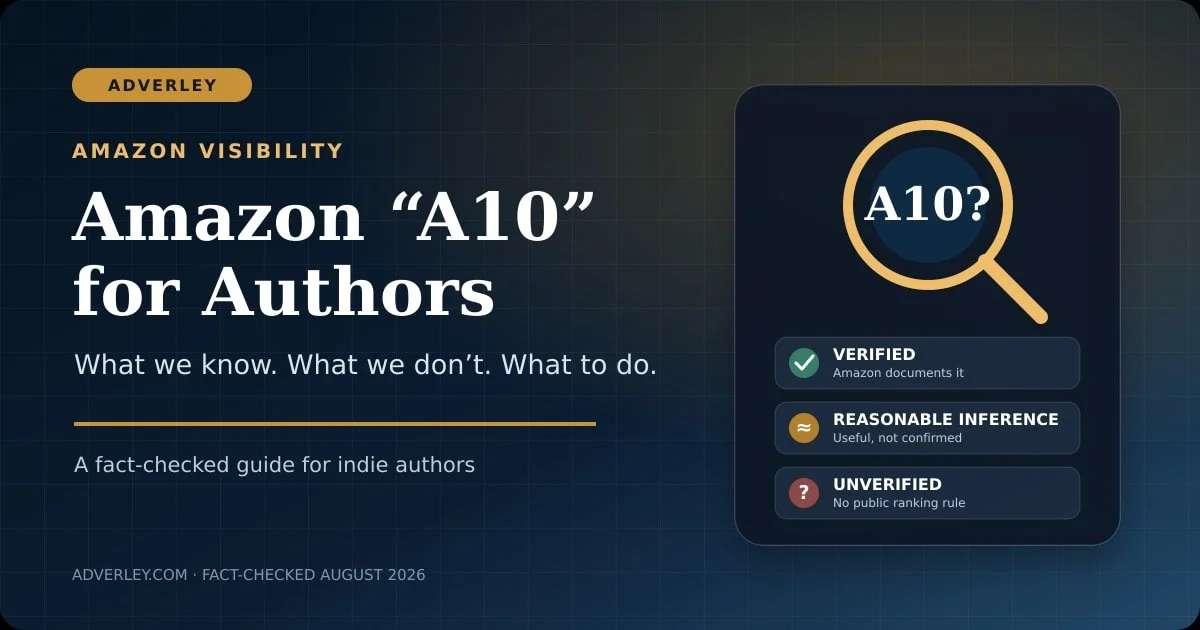
New Insights on Amazon’s A10 Update
If your Amazon book sales have taken a hit lately, you're not alone. Behind the scenes, Amazon has quietly rolled out major changes to how books are ranked and discovered. Dubbed the "A10 algorithm," this update shifts the game for indie authors—putting more weight on engagement, relevance, and external traffic. In this post, we break down what’s changed, why it matters, and how you can adjust your strategy to stay visible and keep your sales moving forward.
Have you noticed a dip in your KENP reads or book orders over the past couple of months?
At Adverley, we’ve been researching this trend in detail. After speaking with our AMS representatives, consulting Amazon support, and reviewing recent case studies, one main factor stood out: Amazon’s new ranking and relevance algorithm, previously known as A9, now unofficially referred to as A10.
Since July, Amazon has been prioritizing different ranking factors, meaning that even authors with great books, strong reviews, and steady ads are seeing changes in visibility.
Don’t worry about sounding professional. Sound like you. There are over 1.5 billion websites out there, but your story is what’s going to separate this one from the rest. If you read the words back and don’t hear your own voice in your head, that’s a good sign you still have more work to do.
Be clear, be confident and don’t overthink it. The beauty of your story is that it’s going to continue to evolve and your site can evolve with it. Your goal should be to make it feel right for right now. Later will take care of itself. It always does.
Here’s a quick breakdown of what’s changed and how it affects your books: A9 vs. A10 Differences.
1. Emphasis on Organic & External Traffic:
A10 now rewards listings that bring in outside visitors (from Google, social media, or newsletters). External traffic is now a major ranking factor, while A9 mainly focused on internal signals.
2. Reduced Reliance on Paid Ads
PPC ads alone no longer guarantee ranking boosts. A10 values genuine reader engagement: organic clicks, sales, and repeat visits, more than ad-driven traffic.
3. Focus on Long-Term Engagement:
Instead of rewarding fast launch spikes, A10 prioritizes sustained engagement, such as consistent sales, KENP reads, and reader retention. Natural keyword use now outperforms keyword-stuffed titles.
4. Seller/Author Authority & Listing Quality:
Amazon now weighs factors like seller credibility, feedback, and listing quality. Well-structured blurbs, professional covers, clear descriptions, and updated A+ content all play a larger role.
5. “Google-Like” Search Behavior:
Search results are becoming more personalized. Amazon tracks engagement quality —CTR, conversion rate, and time on page —similar to Google’s approach to relevance.
What This Means for Authors:
A10 is more holistic. It still values sales, but now emphasizes authentic engagement, off-site visibility, and professional presentation. One-day sales bursts or keyword-heavy strategies no longer have the same impact.
-
Update Your Book Page – Polish your title, subtitle, cover, and description. Make it professional and reader-focused.
Tighten Your Keywords – Use relevant, specific search terms that real readers would type in. Avoid keyword stuffing.
Fix Your Categories – Make sure your book is listed in the most accurate, high-visibility categories.
Audit Your Cover – Genre-fit is non-negotiable. If it doesn’t scream your genre, redo it.
Drive External Traffic – Send readers from social media, email, blogs, or podcasts to your Amazon book page. A10 rewards it.
Build (or Use) Your Email List – Email subscribers are golden. Send them directly to your Amazon page during launches or promos.
Run Facebook or TikTok Ads (Strategically) – Use ads to bring in external traffic. Track results. Optimize.
Fix Your “Look Inside” – First 10% of your book should hook the reader. If not, edit it now.
Watch Your Return Rate – Misleading blurbs or bad formatting can cause refunds. Fix what’s breaking trust.
Ask for Reviews (Gently) – At the end of your book, ask readers to leave an honest review if they enjoyed it.
Aim for Quality Reviews – 10 thoughtful reviews beat 50 generic ones. Depth matters more now.
Track Your Conversion Rate – Use tools like Amazon Attribution or KDP reports to see what’s working.
Don’t Rely Solely on Amazon Ads – A10 favors a mix. Organic + external > pure PPC.
Sustain Your Launch for 30 Days – Launch week isn’t enough. Promote your book consistently for the first month.
Engage Your Readers – Reply to comments, thank reviewers, share behind-the-scenes. Build trust and loyalty.
How We’re Responding:
We’re expanding our program to help authors adapt and thrive under the new A10 rules.
Here’s what we’re adding starting in November:
• Social Media Management
20 image creatives per month, captions, and engagement (Facebook, Instagram, and possibly TikTok).
• Cross-Platform Advertising
Facebook ads focused on newsletter growth and traffic to Amazon and author stores.
• AMS Optimization
Continued ad management to sustain algorithmic visibility and reader momentum.
• Product Page Enhancements
Updated blurbs, new A+ content, and optional “re-release” editions of Book 1s to reset visibility.
Program Details:
We’re currently offering this expanded package at:
$850/month for current clients
$950–$999/month for new clients
This includes AMS management, Facebook ad management, content creation, engagement, and creative production; all integrated for a single price.
From our research, no other agency offers this complete scope of services at a similar rate.
We can also tailor a custom plan if you have specific goals or platforms in mind.
Our goal remains simple:
To provide a complete solution that lets you focus on writing, while we handle the marketing, optimization, and growth.
We’re currently onboarding a few authors into this new A10-ready program, but since we’re training new team members, only a few spots are available at the moment.
If you’d like to reserve a spot or keep your current plan while we transition, please reply and let me know how you’d like to proceed.
We completely understand that not every author will want or be able to upgrade to the full A10 package right away.
If you’d rather keep things simple, our plans start at $350. We’ll still make sure your ads and listings are aligned with the new A10 requirements as much as possible within your service package.
Our goal is to help you adapt and keep your catalog competitive, even with a smaller setup. Of course, the full range of services, like social media management, creative production, and multi-platform coordination, will remain exclusive to the expanded program.
But we’ll always do our best to help you implement a solid version of the strategy at your current level.
Thank you for taking the time to read through this; I know it was a bit longer than usual, but there’s a lot to cover about these recent changes and how they affect advertising. If you’d like to dive deeper into any of these points, just let me know.
Gerardo.
Adverley