109,253 Views and 49 Link Clicks: The Bigger Reader-Acquisition Story
Gary McAvoy's seven short-form videos show why direct clicks are only one layer of demand creation, audience growth, and series-reader acquisition.
Forty-nine link clicks from more than 109,000 views can look disappointing if the only campaign objective is immediate traffic.
But that was not the only job of this program. The videos were also designed to introduce a thriller world, create repeat recognition, grow Gary's owned audience, and place more potential readers near a thirteen-book series. That broader objective does not make link clicks irrelevant. It changes the evidence required before calling the program successful or unsuccessful.
This is the same distinction authors should make when evaluating Amazon Ads: a front-end metric describes one part of the system. The business verdict depends on the campaign job, the reader journey, and the catalog economics.
The first decision: what job is the video supposed to do?
A low click count is not automatically acceptable, and a high view count is not automatically valuable. The scorecard must be selected before the results arrive.
| Campaign job | Primary evidence | The question it should answer |
|---|---|---|
| Immediate traffic | Tagged link clicks, detail-page views, purchases, units, and acquisition cost | Did the video create traceable Amazon visits and transactions now? |
| Audience capture | Follows, repeat viewers, profile activity, and meaningful interactions | Did viewers choose an ongoing relationship with the author? |
| Series-reader acquisition | Book 1 orders or borrows, net royalties, read-through, total account contribution, and payback | Did the acquired audience become economically valuable readers over time? |
If direct response is the declared objective, 49 recorded link clicks are a weak result and should trigger funnel work. If audience creation and series discovery are also declared objectives, the same 49 clicks are one signal among several. That is not moving the goalposts. It is preventing one metric from answering a question it was not designed to answer.
What "A10-aligned" means - and what it does not mean
Adverley uses A10-aligned as internal shorthand for connecting off-Amazon discovery to measurable customer activity. It is not the name of an Amazon program, and it is not a claim that we know a private ranking formula.
Amazon's public KDP guidance describes search results as dynamic and points authors toward relevant book information and keywords. It does not identify a Facebook or Instagram view as a direct ranking factor. Amazon Attribution is the appropriate measurement bridge when an eligible KDP author sends trackable non-Amazon traffic to Amazon.
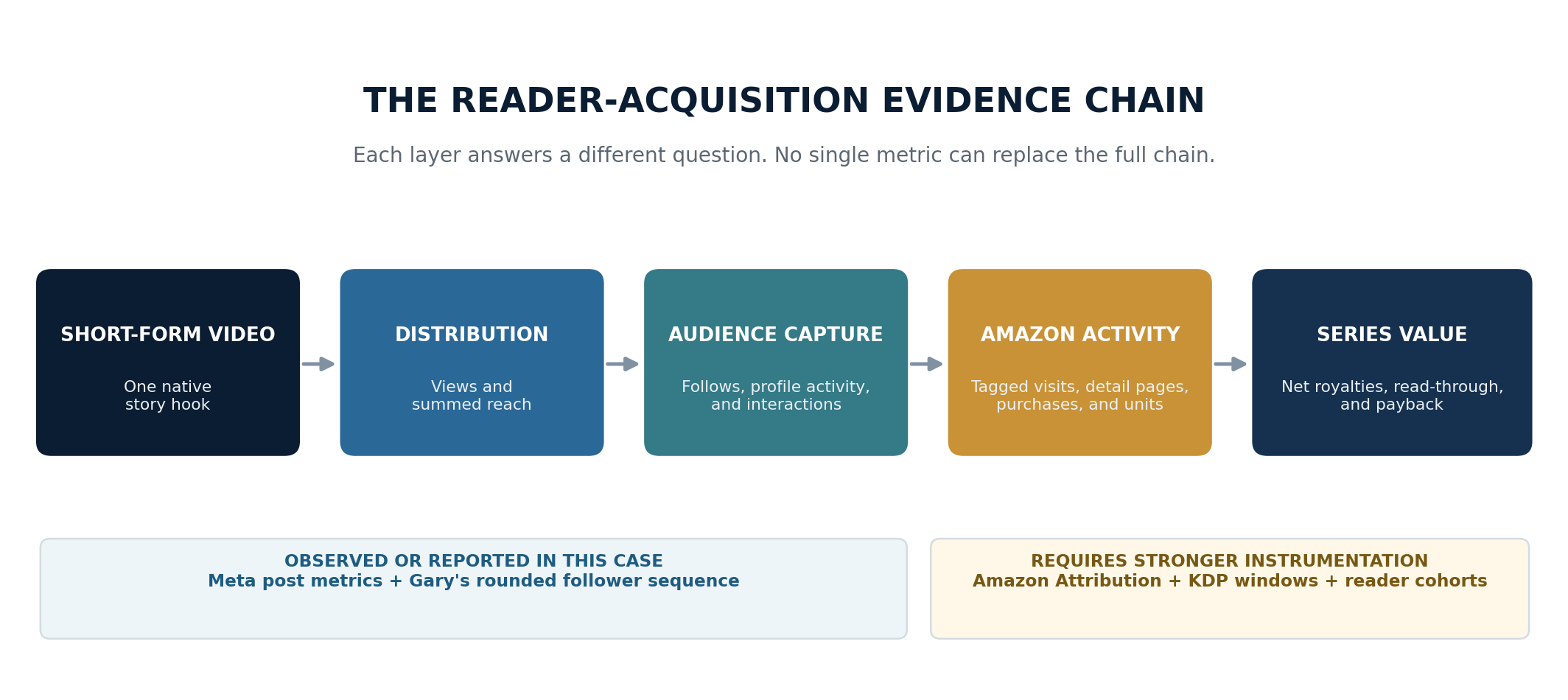
The strategy is aligned with customer activity, not with a theory that views themselves manipulate Amazon. A viewer may follow Gary, visit his profile, click immediately, search for him later, encounter an Amazon ad, borrow Book 1, or buy elsewhere. Some of those paths can be measured. Others require controlled testing or remain unattributed.
The Gary McAvoy video format
Gary McAvoy writes historical conspiracy thrillers with a recognizable story world and a deep series. That catalog depth matters because a newly acquired Book 1 reader can continue beyond the first transaction. It does not prove that any specific video caused downstream royalties.
The seven supplied Reels were approximately 20-21 seconds long and crossposted across Facebook and Instagram. Each one used a compact creative architecture:
- Scene 1: interrupt the scroll. Lead with a historical fact, forbidden location, dangerous object, or destabilizing question.
- Scenes 2 and 3: escalate one mystery. Reveal enough evidence, atmosphere, or character risk to create an information gap.
- Closing frame: bridge to the series. Use the cover, title, and a concise next step so later searchers can identify the book.
The videos are not compressed plot summaries. Each clip sells one compelling idea and contributes to a recurring content identity. That consistency gives both the audience and the platform multiple opportunities to recognize the same author world.
The observed results: seven Reels and 109,253 views
We excluded the cover-photo row visible in the supplied Meta Business Suite screenshot and analyzed the seven rows identified as Reels. The labels below are shortened from the opening text visible in the report.
| Reel label | Reach | Views | Viewers | Interactions | Link clicks | Reactions |
|---|---|---|---|---|---|---|
| Routine restoration | 8,236 | 10,780 | 8,139 | 201 | 7 | 158 |
| Beneath the Vatican | 36,740 | 43,984 | 36,580 | 984 | 15 | 871 |
| Agnese evidence | 943 | 2,250 | 1,143 | 89 | 7 | 66 |
| Every secret | 1,209 | 2,384 | 1,382 | 74 | 1 | 56 |
| Founded that day | 969 | 2,396 | 1,216 | 70 | 4 | 58 |
| Rome, 1503 | 35,933 | 45,536 | 36,540 | 526 | 14 | 459 |
| Volcanic ash | 869 | 1,923 | 983 | 63 | 1 | 47 |
| Summed post metrics | 84,899 | 109,253 | 85,983 | 2,007 | 49 | 1,715 |
Finding 1: the portfolio created the breakout
The average Reel generated 15,608 views, but the median was only 2,396. The typical post therefore did not produce 15,000 views. Two breakout posts lifted the average.
Beneath the Vatican and Rome, 1503 produced 89,520 combined views, or 81.9% of the total. They also produced 85.6% of summed reach and 75.2% of all interactions.
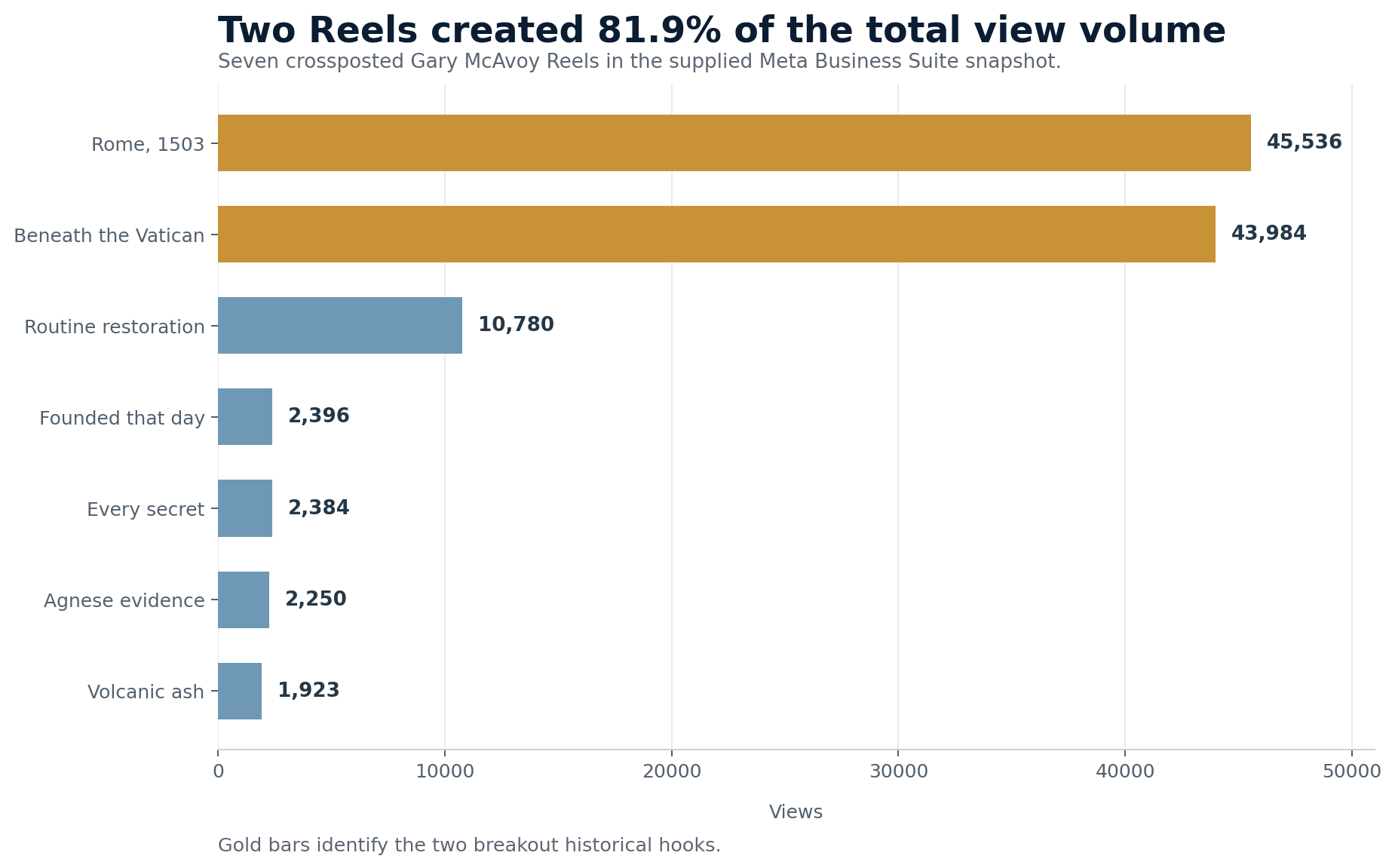
That uneven distribution is normal operating information, not an argument that every low-view post was successful. The smaller posts established a baseline, gave the audience additional touchpoints, and created more chances to find a breakout. The correct response is to increase the share of concrete historical-place, date, institution, and hidden-history angles while continuing to test other motives.
Finding 2: reach leaders did not capture every action
The two breakout Reels generated 81.9% of views and 75.2% of interactions, but only 59.2% of link clicks. The other five Reels produced 40.8% of all recorded clicks from just 18.1% of views.
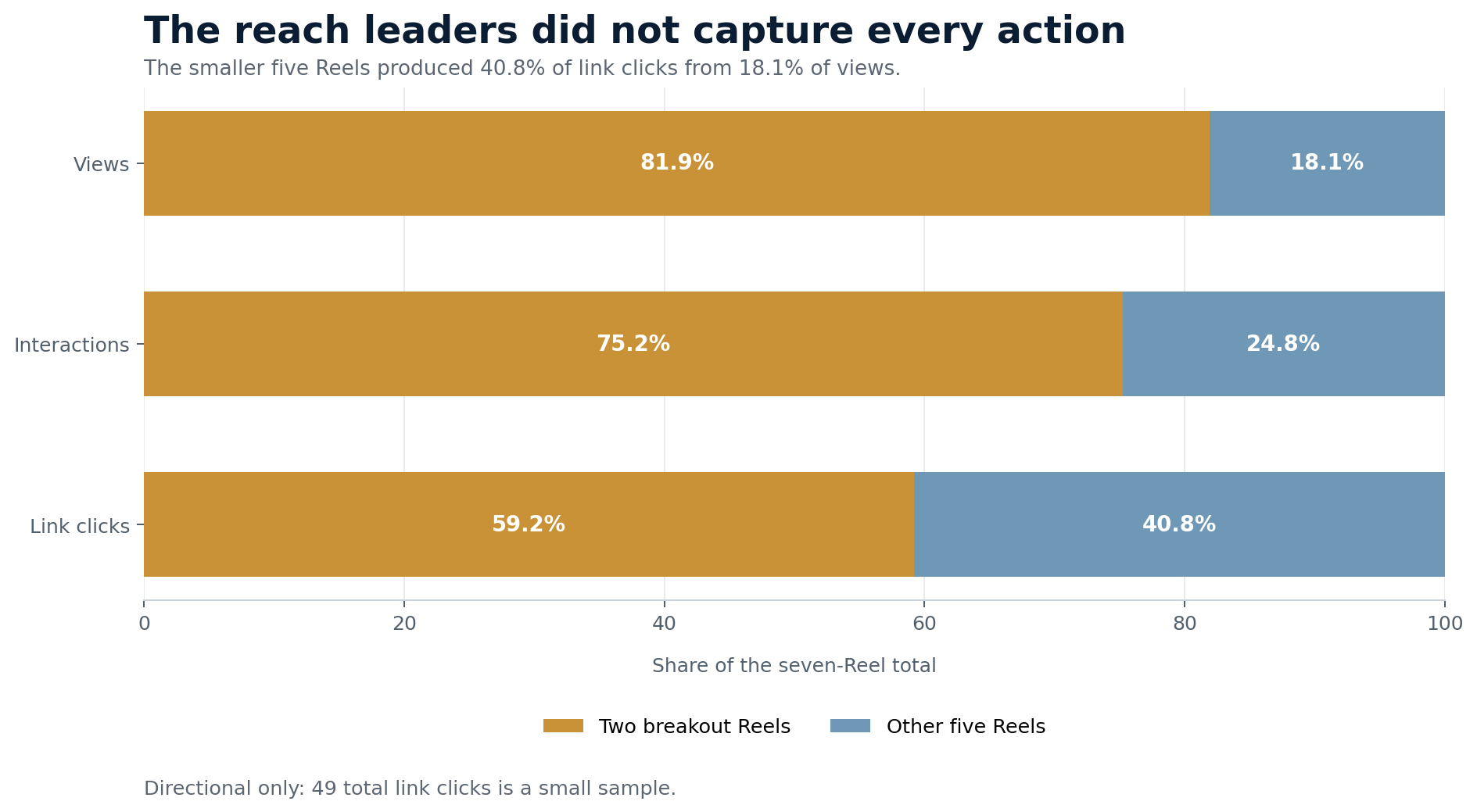
The Agnese evidence Reel generated seven link clicks from 943 reached accounts - the same click count as Routine restoration, which reached 8,236 accounts. Founded that day generated four clicks from 969 reached accounts.
Discovery track
World-building, historical dates, forbidden locations, and major mysteries create reach, recognition, and follower potential.
Action track
Evidence, character jeopardy, and sharper narrative questions may reach fewer people while prompting more immediate behavior.
A serious video program needs both tracks. Reach expands the prospect pool. Action concepts identify which ideas move readers closer to a profile, a link, or a later search.
Finding 3: followers created a reusable audience asset
Gary's strongest feedback was not about the 49 clicks. It was about people choosing to follow.
"Each time you post a video, I get a huge surge of FB followers signing up for me, literally over 100 per day this past week."
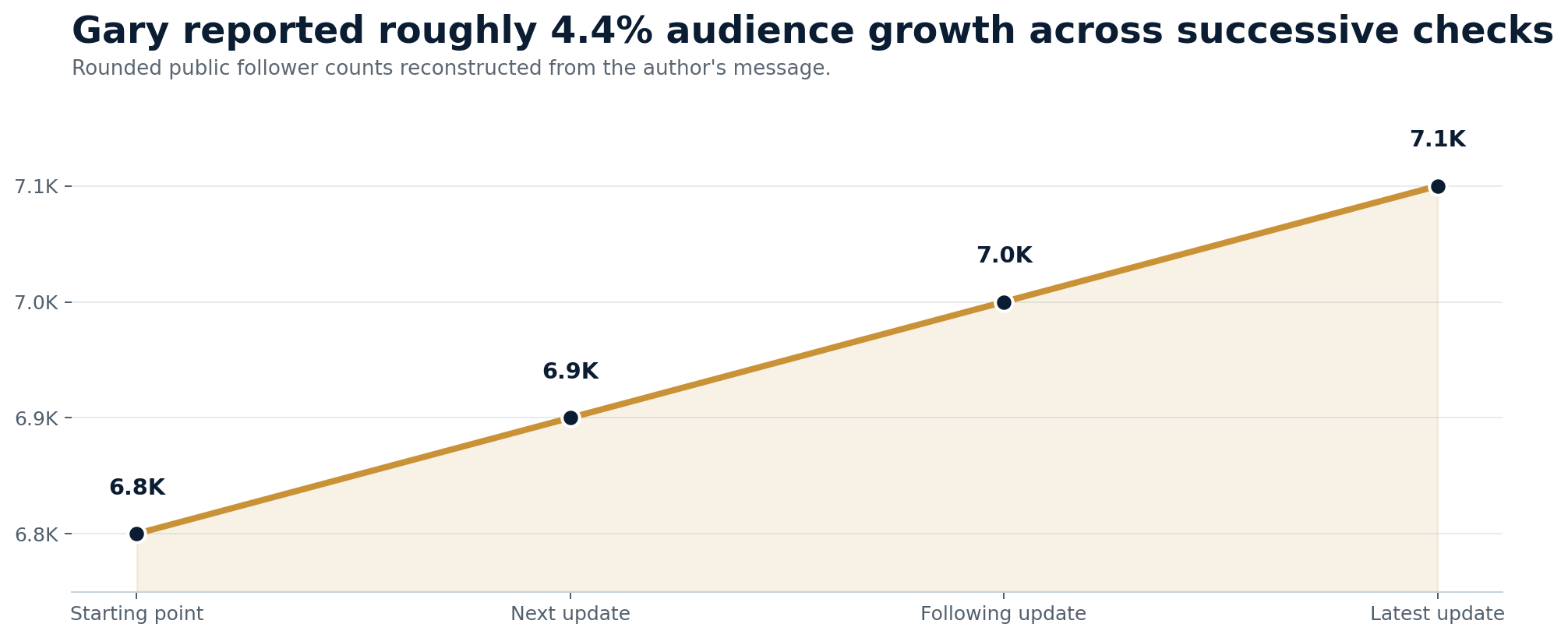
He described the rounded public count moving from approximately 6.8K to 6.9K, then 7.0K, then 7.1K across successive daily checks. We therefore describe the movement as roughly 300 followers, or approximately 4.4% growth from the starting count. We do not present it as an exact platform-exported acquisition report.
"People are even saying, 'I love these little clips.'"
That response matters because the content was becoming an audience product rather than a series of isolated advertisements. A follower can see future launches, new clips, and book announcements without requiring the author to reacquire the same attention from zero every time. The economic value of that audience still has to be measured; follower count alone is not revenue.
Finding 4: the reported sales spikes are relevant - but not causal proof
Gary also reported seeing a small spike in sales on days when Adverley published a new video. Because he observed the pattern repeatedly, it belongs in the business review. It should not be upgraded into a precise conversion or return-on-investment claim.
No exact day-level KDP export, Amazon Attribution report, randomized holdout, or matched non-publishing control was supplied for this case study. Amazon Ads were also operating in the wider account. We therefore cannot allocate every sale between video, advertising, branded search, existing readers, or other demand sources.
The 49 recorded link clicks do not disprove influence either. A viewer can follow first, visit the profile, remember Gary's name, search Amazon later, or respond to a later Amazon ad. Those paths are commercially plausible, but plausibility is not measurement.
Where series economics enter the video decision
Gary's deep series changes the potential value of one acquired reader. A person who enters through Book 1 can continue through additional titles, which means the first observable click or purchase is not necessarily the complete commercial outcome.
That does not give video - or Amazon Ads - a free pass. It raises the standard of analysis. Adverley needs evidence that total royalties, reader progression, and payback justify the combined acquisition cost. It should not shrink a productive audience program simply to make one front-end metric look prettier, and it should not call a program profitable merely because the series is long.
The companion article, Low ACoS or Better Reader Acquisition?, explains how to separate front-end efficiency from account-level profitability. The reader-economics calculator and workbook provides the next step for modeling royalties, read-through, and payback.
How to turn the signal into a measurable reader-acquisition system
The next stage is not simply publishing more clips. It is strengthening the evidence chain from creative concept to catalog contribution.
- Declare the campaign job. Decide whether each video is primarily intended for immediate traffic, audience capture, launch discovery, or series-reader acquisition.
- Assign every Reel a creative ID. Record the hook, story angle, platform, post time, destination, and closing call to action.
- Use Amazon Attribution where eligible. Amazon currently makes the free solution available to eligible KDP authors and reports a 14-day attribution window with clicks, detail-page views, add-to-carts, purchases, units, and product sales.
- Track audience capture separately. Record follows, repeat-viewer behavior where available, profile activity, and interaction quality instead of collapsing them into a traffic result.
- Overlay KDP windows. Compare orders and KENP across the publishing day, the following 24-48 hours, and defined non-publishing baselines.
- Log competing demand drivers. Record Amazon Ads budget changes, price promotions, newsletter sends, releases, and other events that can move the account.
- Measure the catalog outcome. Review net royalties, Book 1-to-Book 2 progression, deeper read-through, total contribution, and the payback period the author can sustain.
The operating playbook we would scale
1. Keep the 20-second micro-story structure
Three visual beats plus a cover bridge are enough to create tension without turning the Reel into a plot summary. Every scene should advance one idea.
2. Build a portfolio, not one "perfect" video
Allocate concepts across historical secrets, locations and dates, artifacts, character jeopardy, institutional conflict, and restoration. The supplied data gives historical specificity more weight for reach while preserving character and evidence hooks for action testing.
3. Repurpose the source of curiosity
A winning "Rome, 1503" concept can become a related location reveal, historical object, character consequence, or question-led variation. Reuse the curiosity mechanism without cloning the same edit.
4. Make the route to the book obvious
Keep the author name, book title, series order, profile link, and Amazon destination consistent. A later search can only work if the reader remembers what to search for.
5. Optimize each evidence layer
Improve distribution without sacrificing relevance. Improve clicks without suppressing audience growth. Improve Amazon conversion without forgetting read-through. The objective is sustainable reader acquisition, not a single attractive dashboard number.
When low clicks should trigger a change
"Clicks are not the whole story" should never become an excuse for weak execution. A low-click video program needs intervention when:
- Immediate traceable traffic was the declared primary objective.
- Amazon Attribution shows little detail-page or purchase activity over the agreed window.
- Follower growth, profile activity, branded search, and repeat engagement are also absent.
- Total royalties and reader progression are not moving as production and advertising costs rise.
- The author's catalog is too shallow, or read-through too weak, to support delayed payback.
- The profile, landing route, book page, or series order creates avoidable friction.
- The creative is generic, inconsistent, or disconnected from the actual book world.
A higher acquisition cost or a lower click rate raises the evidence requirement. It does not automatically issue the final verdict.
Frequently asked questions
Are 49 link clicks low for 109,253 views?
Yes, if immediate direct traffic is the only objective. It is not enough information to judge a mixed discovery and reader-acquisition program because the same period also produced interactions, reported follower growth, and reported sales-day movement. Those additional signals still require stronger attribution and catalog-level economics.
Did the videos cause Gary's reported sales spikes?
The timing is a meaningful client-reported association, not proof of incrementality. Establishing causation would require exact daily data, attribution tags, controls for other marketing, and ideally a structured test or holdout.
Does Facebook or Instagram traffic directly improve Amazon's A10 ranking?
Amazon's public guidance does not identify a social-media view as a direct ranking factor. Adverley uses "A10-aligned" to describe a strategy that creates external discovery and then measures qualified customer activity on Amazon.
Can short-form video make a high-ACoS account profitable?
Not automatically. Video can create demand, audience growth, and additional reader entry, but profitability still depends on net royalties, read-through, acquisition cost, other operating costs, and payback. A high ACoS requires more evidence, not an automatic failure label or an automatic exemption.
What should authors measure besides views?
Track reach, interactions, follows, profile activity, link clicks, Amazon detail-page views, add-to-carts, purchases, units, KDP orders, KENP, net royalties, reader progression, total account contribution, and payback.
Can the strategy work for a standalone book?
Yes, but the economics are usually less forgiving. A standalone has fewer downstream transactions available to recover creative and distribution costs, so direct conversion and faster payback normally carry more weight.
Build a reader-acquisition system, not a vanity content calendar
Adverley's A10 Growth Program connects short-form story creative, organic distribution, Amazon Ads, attribution, and catalog economics. The objective is not more views for their own sake. It is a repeatable system for creating and converting reader demand.
Sources and methodology
- Meta Business Help Center: Insights in Meta Business Suite
- Meta Business Help Center: Facebook Page insights and metric definitions
- Meta Business Help Center: Link clicks definition
- Amazon KDP: How to find your book on Amazon
- Amazon KDP: Add or change book keywords
- Amazon Ads: Amazon Attribution
- Amazon KDP: Reports and reporting timelines
- Gary McAvoy: Books and Reviews
- Google Search Central: Article structured data
Data note: Platform figures were transcribed from the Meta Business Suite screenshot supplied by Adverley. The cover-photo row was excluded. Post-level reach and viewers were summed and may count the same account more than once across different Reels. Follower movement and sales-day spikes are client-reported observations. No exact daily KDP file, Amazon Attribution report, reader cohort, or controlled holdout was supplied, so this article does not estimate incremental sales, conversion lift, downstream video-attributed royalties, or ROI. Results from one author account do not guarantee comparable outcomes for another author.
