Low ACoS or Better Reader Acquisition: What Should Series Authors Optimize For?
Three real accounts—including one with monthly Adjusted ACoS near 439%—show why the correct target depends on reader value, catalog depth, and payback.
“Lower the ACoS” sounds like obvious advertising advice. Sometimes it is the correct priority. Sometimes it is the wrong North Star.
For an author promoting a standalone book, the first transaction carries most of the available value. For an author advertising an entry title in a connected multi-book series, that first transaction may be the beginning of a much longer commercial relationship.
That distinction matters because Amazon Ads reports what it can attribute near the advertised title. It does not produce a complete profit-and-loss statement for the author’s catalog.
At Adverley, we therefore separate two questions:
- How efficiently is the campaign generating attributed front-end value?
- Is the author acquiring series readers at a cost the wider catalog can support?
Those questions are related, but they are not interchangeable. This article explains the difference using three real advertising accounts. Gary McAvoy is identified with permission. The other authors remain Case 2 and Case 3.
ACoS is a front-end efficiency metric—not a profit verdict
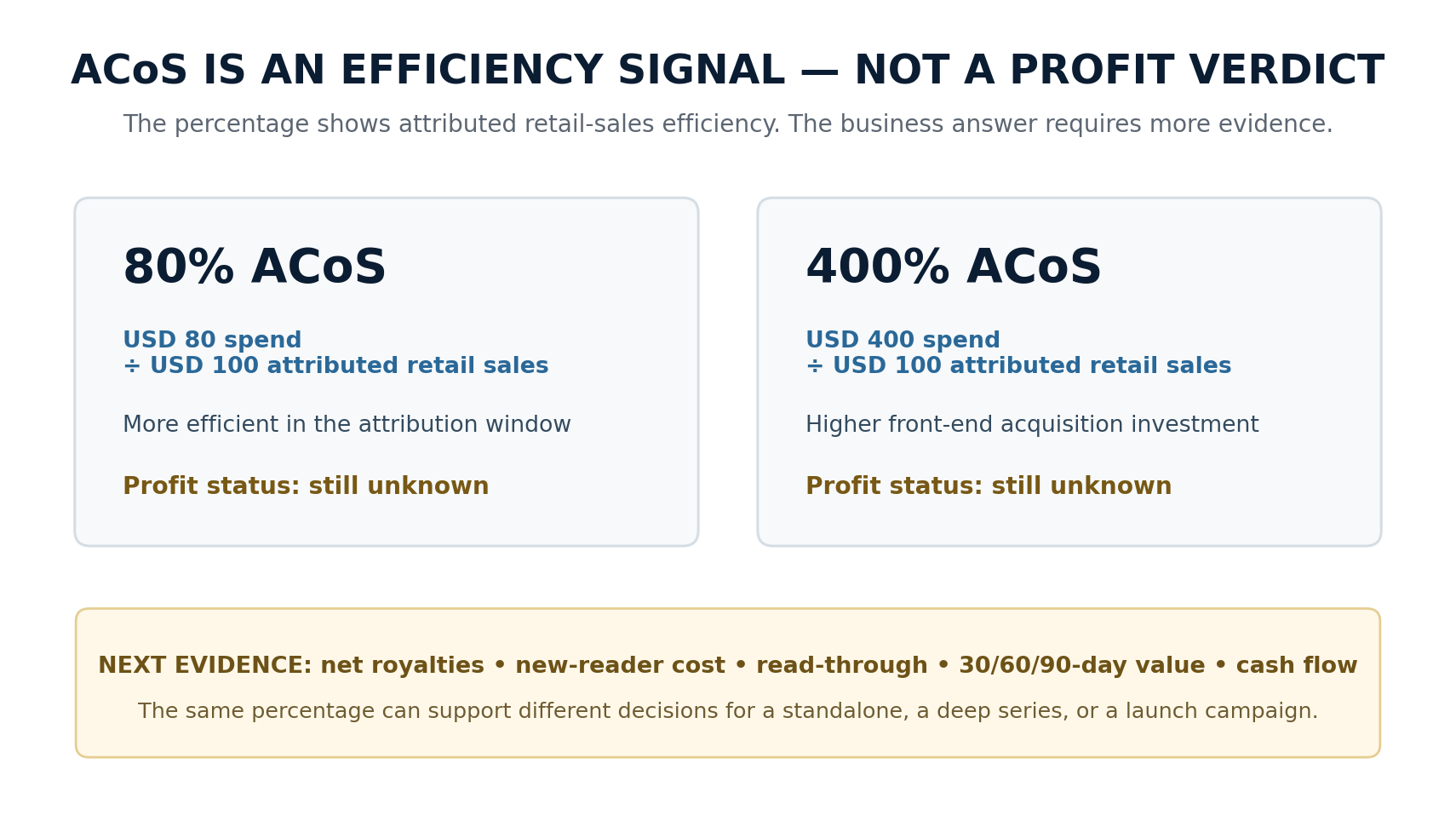
Amazon defines advertising cost of sales, or ACoS, as ad spend divided by ad-attributed sales.
If a campaign spends $80 and Amazon attributes $100 in retail sales, its ACoS is 80%. If it spends $400 and Amazon attributes $100, its ACoS is 400%.
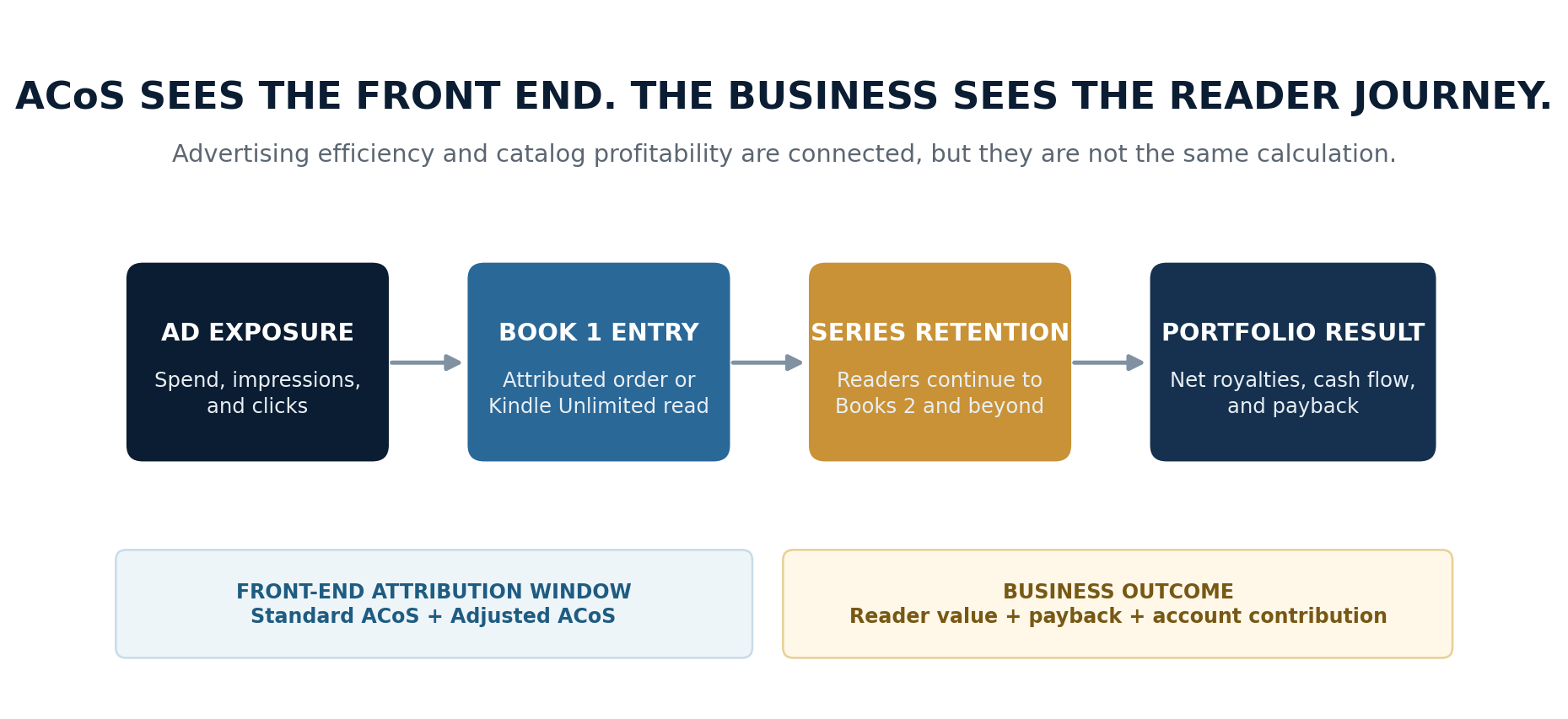
The first campaign is unquestionably more efficient within Amazon’s attribution window. But neither percentage tells us the author’s net royalties, how many buyers were genuinely new to the series, whether Kindle Unlimited readers continued, or what those readers generated elsewhere in the catalog.
Why Adverley also calculates Adjusted ACoS
Amazon Ads reports KENP Read and estimated KENP Royalties for attributed Kindle Unlimited activity. We add that estimated royalty value to the front-end denominator and label the result Adjusted ACoS.
This gives KU-heavy authors a more useful front-end view. It is still not full-series profitability, and it should not be confused with the standard ACoS displayed by Amazon.
The metric that matters depends on the campaign’s job
An author cannot set a sensible ACoS target until the campaign’s business objective is clear. The right scorecard for short-term cash recovery is different from the scorecard for catalog growth.
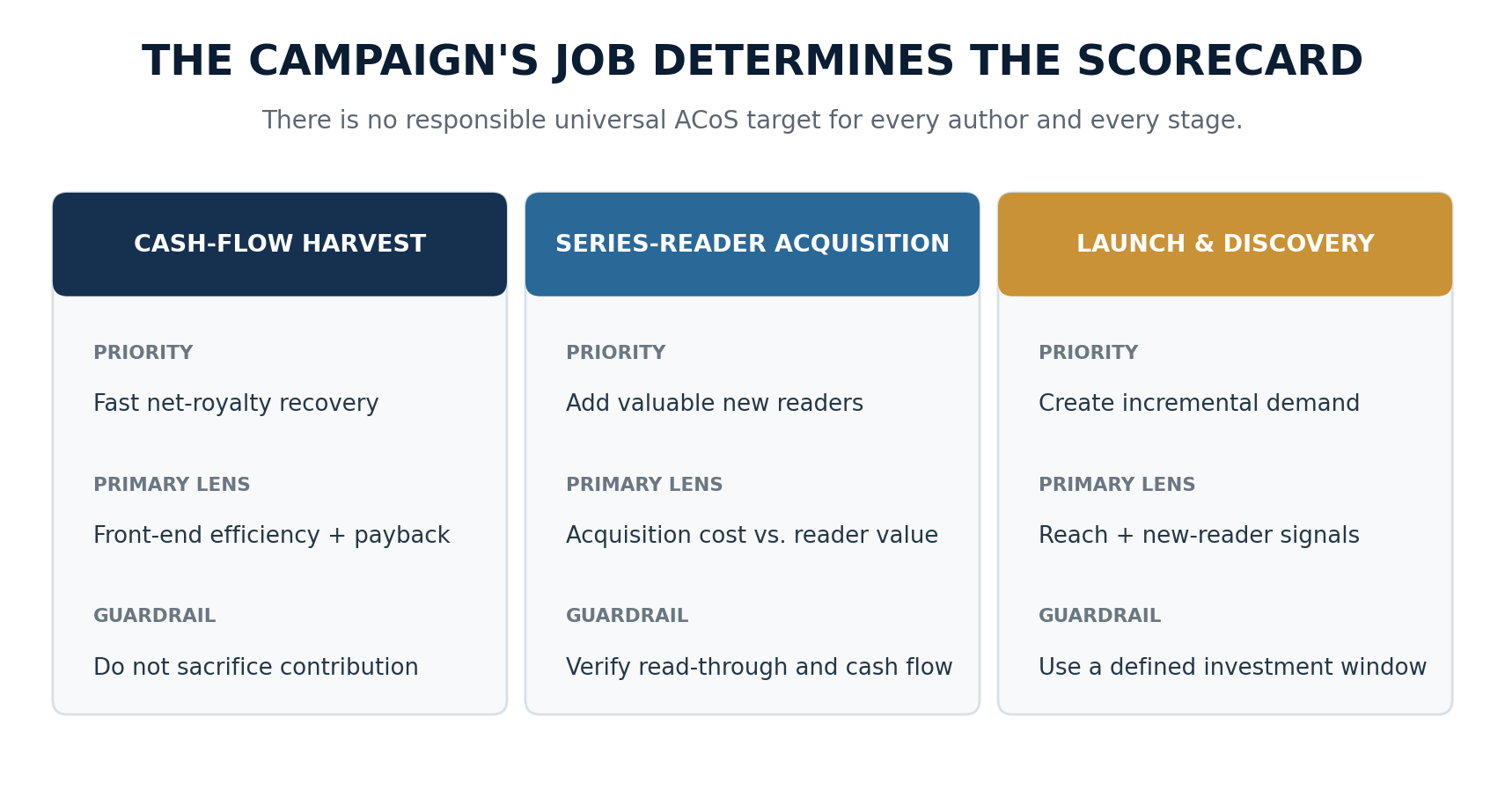
| Campaign objective | Primary decision question |
|---|---|
| Cash-flow harvesting | How quickly does advertising return as net royalty, and how tightly must front-end efficiency be controlled? |
| Series-reader acquisition | Is the cost of bringing a reader into Book 1 lower than that reader’s verified value over the agreed payback window? |
| Launch and discovery | Is a defined investment creating incremental visibility, new readers, audience growth, and catalog movement? |
A lower ACoS is generally helpful. The mistake is treating it as the objective when it is really one constraint within the objective.
What “better reader acquisition” actually means
“Better readers” is not a demographic judgment. It means readers whose observable behavior creates more durable value for the author:
- They finish or meaningfully read Book 1.
- They continue into Book 2 and later titles.
- They generate net royalties across Kindle, KU, paperback, hardcover, or audio where available.
- They may follow the author, join an email list, or respond to future releases.
- The value they produce arrives quickly enough to support the author’s cash flow.
The cleaner business comparison is therefore reader acquisition cost versus realized reader value:
The word verified matters. Catalog depth creates potential value; it does not guarantee that readers will continue.
Why Book 1 changes the economics
All three accounts in this study concentrate advertising on series entry titles. Case 2 and Case 3 involve series containing between seven and thirteen books. Gary McAvoy’s managed program spans three thriller series containing nineteen thrillers in total. Across the accounts, the clients report average read-through of approximately 70%.
That operating model treats Book 1 as the acquisition product. Books 2 and beyond monetize reader retention.
Read-through must still be defined carefully. Some authors use Book 1-to-Book 2 conversion. Others use book-to-book retention, completion through the latest title, or royalty value relative to the entry book. Those definitions cannot be mixed casually.
Case 1: Gary McAvoy—three series and two reporting layers
Gary McAvoy has nineteen thrillers across three series. Adverley’s program has managed paid discovery for entry titles across all three series—not only the thirteen-book Vatican Secret Archive Thrillers.
Gary’s KDP dashboard displayed forty-eight book listings when translations were included as of August 20, 2026. That is a broader publishing-account view. It should not be confused with nineteen thriller titles, the specific ASINs being advertised, or the narrower activity Amazon Ads attributes to paid campaigns.
Layer 1: what Amazon Ads attributed
Across the February–July six-month Amazon Ads reporting window analyzed here, Gary’s campaigns generated:
The combined tracked front-end value, including approximately $671 in Amazon-reported estimated KENP royalties, was approximately $23,465. Front-end attribution therefore did not recover the full $28,246 in advertising spend inside this measurement layer.
If the objective had been immediate recovery from only the outcomes Amazon Ads attributed, that gap would dominate the decision. It was not the complete objective. The campaigns were creating paid entry points across three series and a wider nineteen-thriller catalog.
Layer 2: what Gary reports across the full KDP account
After reviewing the original case study, Gary correctly pointed out that the Amazon Ads figures represented only a small portion of his overall publishing activity. He reports the following account-wide scale:
These account-wide numbers are intentionally not inserted into the Adjusted ACoS formula. They use a different dashboard, a different date range, and a much broader catalog scope. Mixing them would produce a more flattering percentage, but not a defensible one.
What can Adverley responsibly take credit for?
Adverley can take credit for managing the campaigns that delivered the directly attributed results above and for maintaining paid discovery across all three series during the period. Gary’s wider KDP performance demonstrates the size and downstream potential of the business in which those campaigns operated.
What we cannot responsibly claim is that every account-wide order, KENP page, translation read, organic sale, or later-series royalty was caused by advertising. The more accurate conclusion is that managed advertising was one measurable component of a substantially larger reader-acquisition and catalog system.
“Trusting my ad management to Adverley was the best decision I’ve made in my marketing efforts this past year.”
— Gary McAvoy, testimonial published on Adverley.com
Gary reports the program as profitable at the broader series and account level. His statement and account totals are client-reported business evidence; they are not a claim that every downstream sale can be causally assigned to one ad click.
Case 2: growth that outpaced the increase in spend
Case 2 generated 8.79 million impressions, 8,568 clicks, 520 orders, and 315,190 Amazon-reported KENP pages over six months. Its aggregate Adjusted ACoS was approximately 114%.
More important than the isolated percentage was the direction of the business. Comparing the first three months with the following three:
- Ad spend increased 118%.
- Orders increased 151%.
- Ad-attributed sales increased 174%.
- KENP pages increased 75%.
- Combined tracked Book 1 value increased 136%.
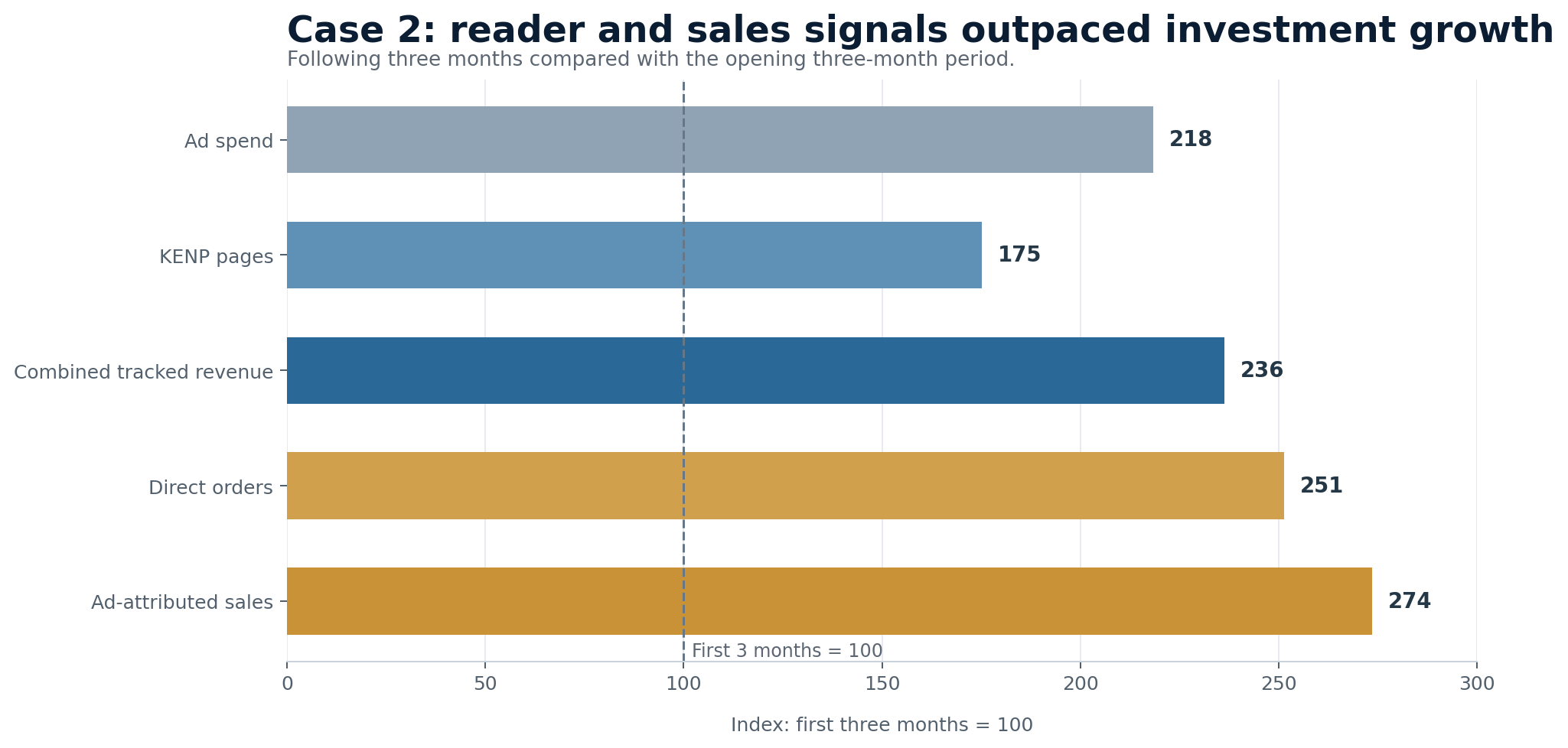
Average reported sales increased from $12.68 per day in February to $33.31 per day in July, while July KENP reached 84,429 pages. The client reports that the account remains profitable when the wider series is considered.
Case 3: why a 400% month is not automatically a failed month
Case 3 is the account most likely to be misclassified by a generic ACoS benchmark.
Its monthly Adjusted ACoS ranged from approximately 228% to 439% during the supplied period. The aggregate figure was approximately 273%.
Those numbers tell us that Amazon-attributed Book 1 sales and estimated KENP royalties recovered a smaller portion of spend within the front-end reporting window. They do not, by themselves, tell us whether the author’s business lost money.
The client reports the account as profitable after considering the wider series. That is why we do not label the 438.78% month a failure simply because it crossed an arbitrary threshold. We ask whether total royalties, reader progression, cash flow, and the agreed acquisition objective support continued investment.
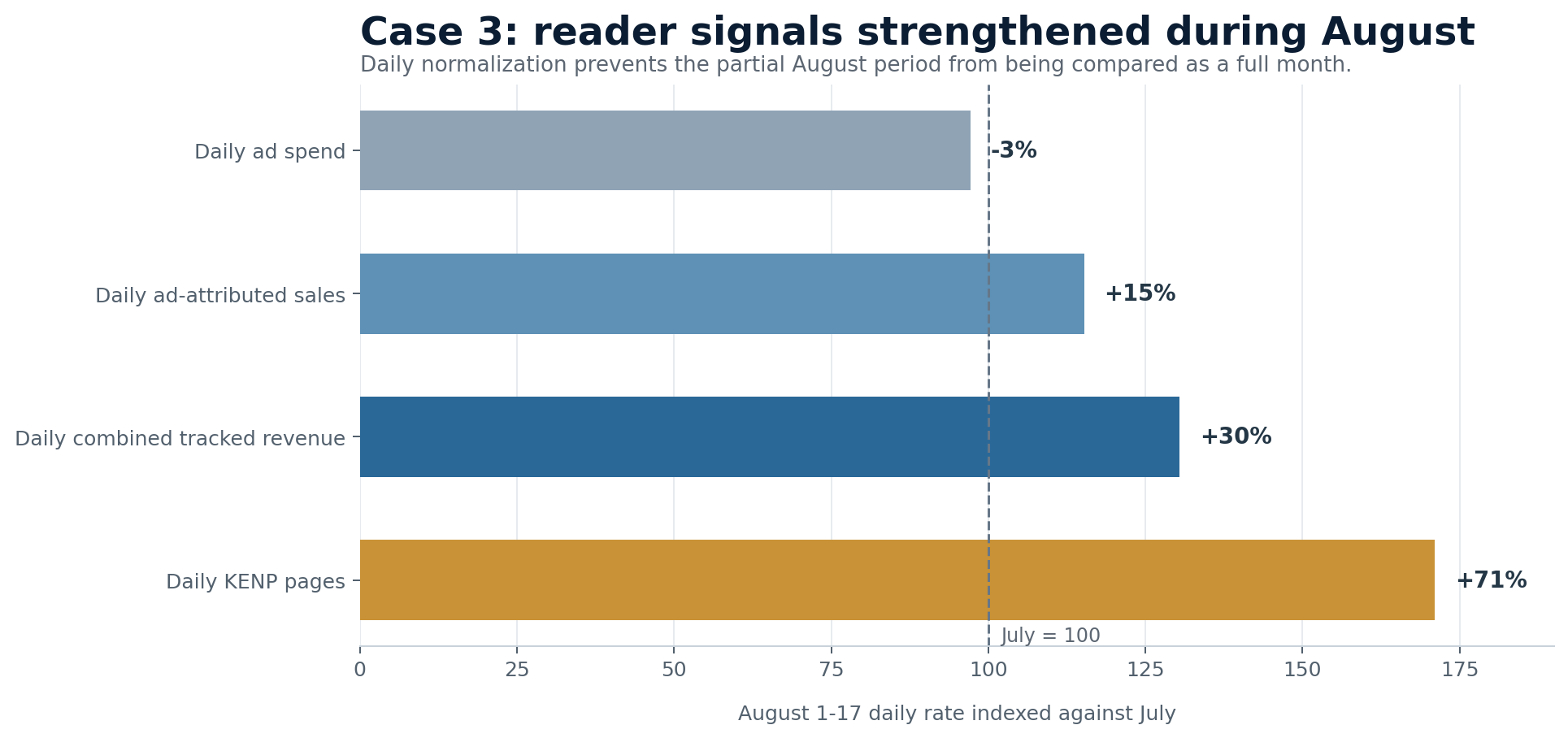
The latest reporting period also showed improving reader signals. Comparing August 1–17 daily rates with July:
- Daily advertising spend decreased approximately 3%.
- Daily ad-attributed sales increased 15%.
- Daily KENP pages increased 71%.
- Daily combined tracked value increased 30%.
Demand creation also extends beyond direct clicks
Reader acquisition does not always occur in a single measurable click. An author may be discovered through a short video, remembered later, searched by name, and then purchased or borrowed on Amazon.
Gary reported sales spikes on days when new short-form videos were published. Two of the strongest videos generated 89,520 combined views and 1,510 interactions, while producing only 29 direct link clicks. His Facebook following also moved from approximately 6,800 to 7,100 over three days.
That pattern does not prove that every view caused a sale. It demonstrates why link clicks should not be treated as the complete influence path. The detailed methodology appears in our A10-aligned organic video case study.
The series-author scorecard
| Metric | What it should be used to answer |
|---|---|
| Standard Amazon ACoS | How much spend Amazon required for each dollar of attributed retail sales. |
| Adjusted ACoS | How the front-end picture changes after adding Amazon-reported estimated KENP royalties. |
| Cost per Book 1 order or read | What the campaign spends to create an entry event, without assuming every event is a new reader. |
| Estimated new-to-series acquisition cost | What it costs to acquire a reader who was not already in the author’s audience. |
| Book 1-to-Book 2 read-through | Whether the entry title attracts readers who want the next book. |
| Book-to-book retention | How reader value develops or declines deeper in the series. |
| 30-, 60-, and 90-day reader value | How much net royalty the acquired reader cohort produces over time. |
| Total account contribution | Whether total royalties exceed advertising and other relevant costs at the business level. |
| Payback and cash flow | Whether the author can sustainably wait for downstream value to arrive. |
When should an author prioritize a lower ACoS?
A lower front-end ACoS should carry more weight when:
- The book is a standalone or belongs to a short series.
- The author needs rapid cash recovery rather than audience expansion.
- Read-through is unknown, declining, or too weak to support acquisition.
- Total account royalties are not moving as advertising investment increases.
- The author cannot absorb a 60- or 90-day payback period.
- The campaign is mainly reaching existing readers rather than adding incremental demand.
In those situations, lowering bids, tightening targeting, reducing spend, or improving the product page can be the right response. The decision comes from the business constraint—not from embarrassment about the percentage.
A practical decision process
- Define the campaign job. Decide whether the immediate priority is cash flow, reader acquisition, launch visibility, or a controlled combination.
- Keep ACoS definitions separate. Preserve Amazon’s standard ACoS and label any KENP-inclusive calculation as Adjusted ACoS.
- Measure net royalties, not only retail sales. Profitability must ultimately be evaluated using the money the author receives.
- Build a book-by-book read-through model. Use actual units, KENP, price, and royalty data wherever possible.
- Set a payback window. A campaign that works over 90 days may still be inappropriate for an author who needs recovery in 30.
- Review account-level movement. Compare advertising investment with total catalog royalties, while acknowledging that correlation is not perfect attribution.
- Optimize without changing the objective accidentally. Lower waste and improve conversion, but do not shrink a successful reader-acquisition program merely to produce a prettier ACoS.
Authors who want to model these inputs can use our Amazon Ads reader-economics calculator and workbook.
Frequently asked questions
What is a good Amazon Ads ACoS for a series author?
There is no universal target. A useful target must be derived from net royalties, series length, verified read-through, reader acquisition cost, cash-flow requirements, and the selected payback window.
Can an Adjusted ACoS above 400% still be profitable?
It can coexist with account-level profitability when the series and wider catalog generate enough net royalty value. It is not automatically profitable. The higher acquisition cost increases the amount of downstream value and measurement evidence required.
Does client-reported account profitability prove the ads caused every sale?
No. It confirms the author’s broader business outcome, not perfect causal attribution. Stronger causal evidence requires reader cohorts, controlled budget changes, geographic or audience holdouts, or other incrementality testing where practical.
Should the goal still be to lower ACoS?
Improving efficiency is valuable as long as it does not reduce profitable reader volume or conflict with the campaign’s objective. The goal is not the lowest percentage; it is the strongest sustainable business result.
Do KENP royalties belong in the calculation?
Amazon Ads reports estimated KENP royalties attributed to advertising. Adverley includes them in a separately labeled Adjusted ACoS, while keeping Amazon’s standard ACoS intact.
Does a long series automatically justify a high ACoS?
No. More books create monetization opportunity, but only real reader progression creates value. A deep catalog with weak read-through does not support aggressive acquisition.
Why are Gary’s KDP totals much larger than the case-study figures?
They come from different reporting layers. The case-study totals are outcomes Amazon Ads attributed to the managed campaigns from February through July. Gary’s KDP totals cover his entire publishing account, including organic and otherwise unattributed activity across forty-eight dashboard listings when translations are included. Both can be accurate at the same time.
Set the target from your catalog—not somebody else’s case study
Send Adverley your Book 1 link, series length, approximate read-through, royalty mix, and current advertising data. We can help identify whether your account should prioritize front-end efficiency, reader acquisition, or a different payback model.
Sources and methodology
- Amazon Ads: What is advertising cost of sales (ACoS)?
- Amazon Ads: Kindle Edition Normalized Pages metrics
- Amazon Ads author case study: advertising the first book in a series
- Gary McAvoy: Books and Reviews
- Adverley: Author advertising services and testimonials
Data note: Campaign figures were supplied by Adverley from Amazon Ads reporting. Gary’s 1,527 orders and 176,107 KENP pages are ad-attributed outcomes for February–July, not total KDP activity. Gary reports approximately two million monthly KENP pages and more than 3,000 monthly KDP orders across his full account. His supplied screenshot shows 1,522,288 pages from August 1–20, 2026 across forty-eight KDP dashboard listings when translations are included; it does not show orders or source-level attribution. Case 2 and Case 3 are anonymized. Account profitability and approximate read-through are client-reported and are not presented as audited financial statements. Adjusted ACoS is an internal analytical metric, not Amazon’s standard ACoS. Results describe specific accounts and do not guarantee comparable outcomes for another author.
